
Solar-Electric Catamaran: The 2026 Buyer's Guide to Twin-Hull Solar Boats
A resort operator or private owner comparing a solar-electric catamaran against a conventional diesel launch this year is not choosing between a proven idea and an experiment. Silent Yachts crossed the Atlantic on solar power alone back in January 2018 with the Silent 64, and the global electric boat market was already valued at 6.78 billion US dollars in 2024, with leisure boats making up the largest single share at 42.1 percent, according to Grand View Research. Singapore put its first solar-electric ferry on the Singapore River in April 2025.
What most guides on this topic skip is the actual engineering reason a catamaran hull, specifically, keeps showing up in every serious solar-electric boat on the market. It is not styling. It is physics, and it changes what a buyer should actually check before signing off on one. This guide covers how twin hulls make solar-electric propulsion practical, what real vessels on the market cost and deliver, the hull material decision that shapes maintenance for decades, and where Chorus's Duet catamaran fits.
What Is a Solar-Electric Catamaran?
A solar-electric catamaran is a twin-hull boat that generates some or all of its propulsion power from deck-mounted solar panels feeding an onboard battery bank, which then drives one or more electric motors. The twin-hull design is not incidental. It is what makes the solar panels and battery weight practical in the first place.
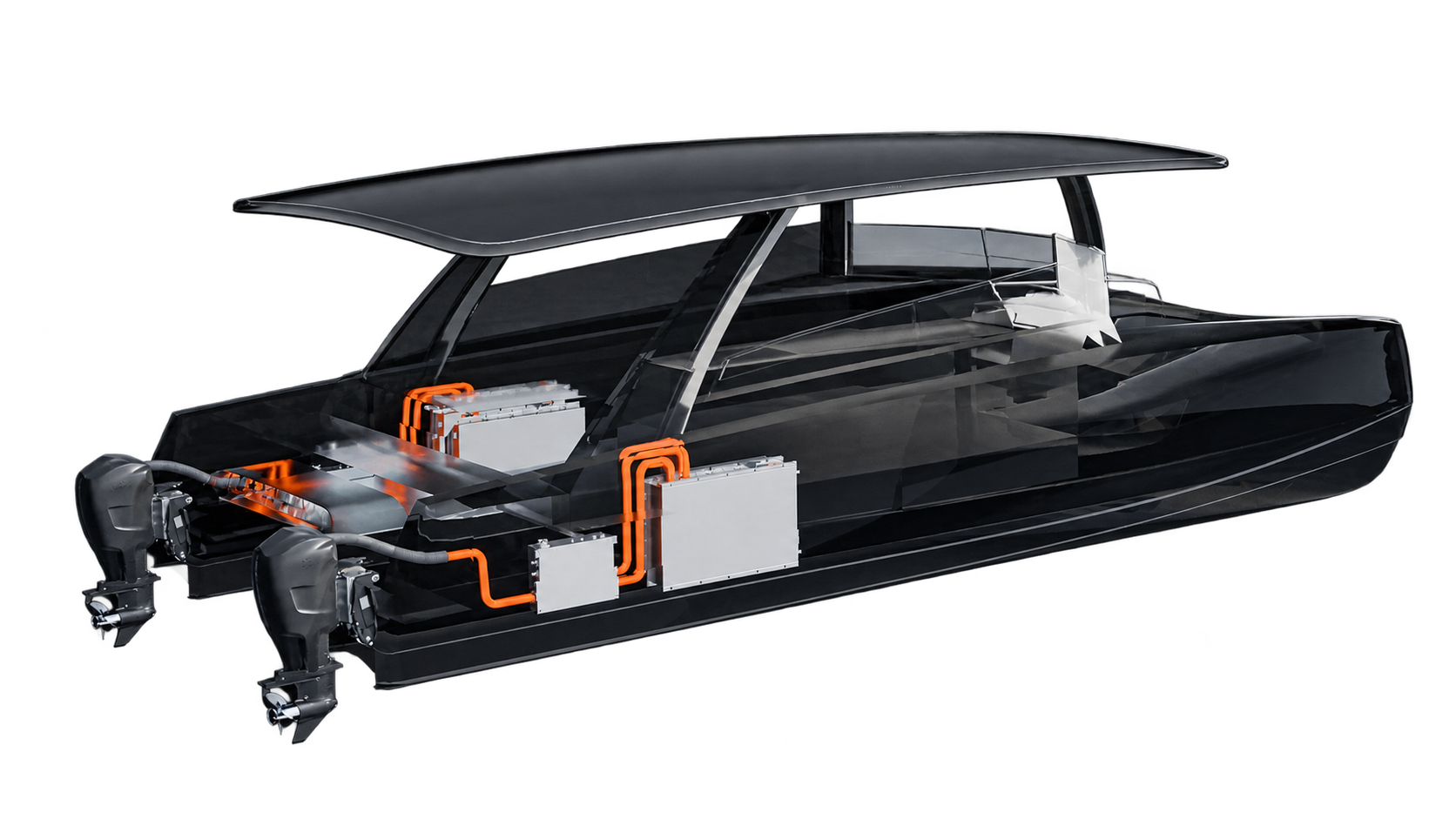
The category ranges from small excursion catamarans built for lagoon and harbour transfers up to ocean-capable production yachts. Silent Yachts, the Austrian-founded, Italy-based builder, produces the clearest example of the top end: its SY62, SY80, and 120 Explorer models share solar-electric propulsion with a diesel range extender as the common architecture across the range, according to a builder overview on itboat.com. At the compact end, Soel Yachts' SoelCat 12 was built specifically as a resort excursion vessel, running on a 120kWh battery bank powering two 30kW motors, according to Plugboats' reporting on the build.
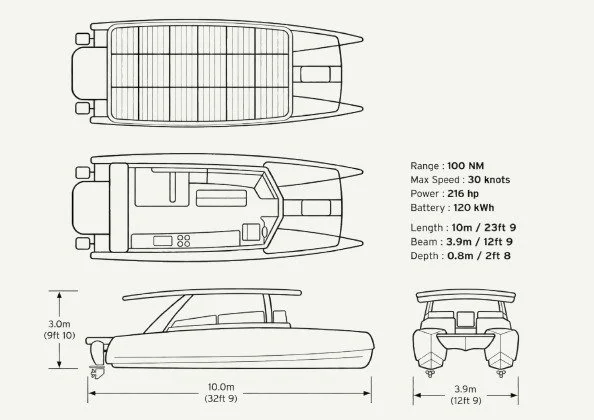
Chorus's Duet, a 10-metre solar-electric catamaran launching from £680,000 (the launch price for the first 20 orders, excluding VAT, local taxes, delivery and selected options), sits in this category as the UK studio's flagship, positioned for resort, charter, and private owner use. Chorus publishes Duet's battery capacity (120+ kWh) and power output (200+ hp) on its own site, though it has not published a specific range figure, which is normal for this segment. Silent Yachts and Soel Yachts are unusually transparent by comparison, and most bespoke builders keep that data for direct commercial conversations rather than a public spec sheet.
Why Do Solar-Electric Boats Use Catamaran Hulls Specifically?
Catamaran hulls give solar-electric boats two things a single hull cannot: a wide, flat deck with enough surface area for a meaningful solar array, and lower hydrodynamic drag per tonne of displacement, so the same battery and panel output covers more distance. Twin hulls are the enabling design choice, not a styling preference.
The drag-to-deck-area trade-off explained
A monohull has to get narrower as it gets faster, which shrinks usable deck space exactly when a solar-electric design needs more of it. A catamaran's two slender hulls create a wide, stable beam without that trade-off, a combination electric-boat marketplace Volta Yachts describes as suiting electric propulsion better than almost any other hull form. Less drag means a smaller, lighter battery bank can still deliver practical range, freeing weight budget for solar panels instead.
The stability case, in plain terms
Catamarans derive stability from the distance between the two hulls, known as transverse clearance: the greater that distance, the greater the stability, according to Wikipedia's overview of multihull design. In practical terms this means a catamaran resists the side-to-side rolling motion that makes single-hull boats uncomfortable at rest or at trolling speed, a benefit World Cat's guide to power catamarans attributes to the twin hulls acting as two separate points of buoyancy rather than one central keel.
Why that matters specifically for solar panels
A rolling, heeling monohull constantly changes the angle its solar panels present to the sun, cutting real-world generation well below the panel's rated output. A catamaran's flatter, more stable deck keeps panels closer to an optimal angle for more of the day. This is a genuinely underdiscussed reason catamaran hulls dominate the solar-electric segment, and it is worth asking any builder directly how much of their range or output figure assumes flat-water conditions versus real chop.
How Much Does a Solar-Electric Catamaran Cost?
Published pricing spans from £680,000, Chorus's launch price for the first 20 Duet orders, up into seven figures for ocean-capable models from Silent Yachts, none of which disclosed pricing for its new 24.38-metre SY80. Entry-level electric boats generally start above 100,000 US dollars, according to Grand View Research's 2025 market report, with solar-electric catamarans sitting well above that floor due to battery and panel costs.
Silent Yachts' SY62 and SY80 do not publish pricing publicly, and Chorus's Duet is the only vessel in this comparison with a confirmed public figure. This is the norm rather than the exception at this end of the market: battery capacity, panel specification, and interior fit-out vary enough per commission that a fixed headline price would mislead more buyers than it would help.
What actually drives the cost difference between models
Battery capacity is the single biggest cost driver. Silent Yachts' SY80 offers a 522 to 696 kilowatt-hour battery option, according to autoevolution's coverage of the launch, roughly four to five times the capacity of the smaller SY60's reported figures. More battery buys more range independent of sunlight, at a direct cost premium that scales close to linearly with capacity.
Solar-Electric Catamarans Compared: What Different Builders Actually Deliver
Buyers choosing between solar-electric catamarans are really choosing between resort-excursion vessels built for short daily runs, and ocean-capable production yachts built for extended solar-only cruising with a diesel backup.
GRP vs Aluminium: Which Hull Material Suits a Solar-Electric Catamaran?
GRP, glass-reinforced plastic, is lighter for a given strength than aluminium and shapes more easily into the hydrodynamically refined hulls solar-electric catamarans need, while aluminium is more impact-resistant and cheaper to repair after a grounding or collision. Most production solar-electric catamarans, Chorus's Duet included, use GRP hulls.
Why GRP dominates this specific category
Pound for pound, GRP is lighter and stronger than aluminium, meaning roughly half the weight of GRP achieves the same strength and stiffness, according to Sirius Yachts' comparison of the two materials. For a solar-electric catamaran, where every kilogram saved on the hull is a kilogram available for battery capacity, that weight advantage compounds directly into range. GRP also moulds into the fine, hydrodynamically refined hull shapes that reduce drag, an advantage yacht broker Yachtlista attributes to fibreglass's flexibility compared with aluminium's flat, welded plate construction.
What aluminium offers instead
Aluminium is roughly ten times the shear strength of fibreglass by weight, according to Starboard Yacht Group figures cited by Yachtlista, meaning it absorbs impact by denting rather than cracking. That matters more for a workboat or patrol vessel operating in debris-heavy water than for a resort excursion catamaran running scheduled routes, which is one reason GRP remains the default across this specific segment rather than aluminium's traditional strongholds in fishing and utility craft, per insurer Progressive's material comparison.
Case Study: The First Solar-Powered Yacht to Cross the Atlantic
Silent Yachts' Silent 64 completed the first Atlantic crossing by a production solar-powered yacht in January 2018, a benchmark the company's successor 60 Series still references directly as proof the architecture works for genuine ocean passages, not just harbour and lagoon use.
The 60 Series that followed carries 42 solar panels feeding a 210 kilowatt-hour battery, delivering up to 100 nautical miles of daily solar-powered cruising range at 6 to 8 knots, with an 18-knot top speed available when needed, according to YachtBuyer's coverage of the range. Silent Yachts has since been recognised across multiple industry awards, including Best Electric Catamaran at the World Yachts Trophies 2025 for the Silent 62 Open, per the brand's own awards listing on YachtBuyer.
The relevance for any buyer weighing this category is straightforward. A solar-electric catamaran that can cross an ocean on panels and battery alone has nothing left to prove about short-haul resort or charter use, where daily distances, sun exposure, and charging access are all far less demanding than a transatlantic passage. The harder question for most buyers is not whether the technology works, but which size and configuration actually matches their route.
Is a Solar-Electric Catamaran Practical for a Resort or Private Fleet?
Yes, for routes under roughly 100 nautical miles a day in reasonable sun, based on Silent Yachts' 60 Series real-world range figures, solar-electric catamarans are practical without a diesel backup. Longer or less predictable routes benefit from a builder that offers a range-extender option, as Silent Yachts does across its full line.
Chorus positions Duet specifically for resort and charter operators who need a near-silent, zero local-emission platform rather than maximum range, a use case that matches how most resort excursion routes actually run: short, repeated, daylight trips where solar recharging between runs is realistic. This is a different buyer brief to Silent Yachts' ocean-passage-focused range, and the two are not really competing for the same customer despite sharing the same underlying hull physics.
Comprehensive FAQ
-
Some models can, under the right conditions. Silent Yachts' 60 Series delivers up to 100 nautical miles of daily range primarily on solar-charged battery power at 6 to 8 knots, according to YachtBuyer, though most owners use shore charging or an optional diesel range extender for longer or cloudier passages rather than relying on solar alone.
-
Yes, measurably so. Stability increases with the distance between the two hulls, known as transverse clearance, according to Wikipedia's overview of multihull design, and the twin-hull configuration resists the rolling motion that causes seasickness on a single-hull boat, a benefit power catamaran builder World Cat attributes directly to the wide, dual-buoyancy platform.
-
GRP suits most solar-electric catamarans better, since it is lighter for a given strength, according to Sirius Yachts, freeing weight budget for battery capacity, and it moulds into the low-drag hull shapes this category depends on. Aluminium remains the better choice for vessels regularly operating in debris-heavy or high-impact conditions, where its dent-rather-than-crack failure mode matters more than weight.
-
Confirmed public pricing starts at £680,000, Chorus's launch price for the first 20 Duet orders (excluding VAT, local taxes, delivery and selected options). Larger ocean-capable models from builders like Silent Yachts do not publish pricing, reflecting how much battery capacity, solar specification, and interior fit-out vary per commission at this end of the market.
-
Range is not directly comparable, since a solar-electric catamaran generates power continuously in daylight rather than carrying a fixed fuel load. Silent Yachts' 60 Series reports up to 100 nautical miles of daily range on solar and battery power alone, which functions differently from a diesel boat's single-tank range and depends heavily on sun conditions and speed.
-
Most benefit from a dedicated shore power connection for battery top-up, even when solar panels handle daytime generation, since overnight charging and cloudy-day backup both depend on it. Confirm available marina capacity against the builder's stated charging draw before committing to a delivery date, the same step recommended for any electric boat purchase.
-
The hull maintenance itself does not differ by propulsion type, only by material, GRP versus aluminium. What changes with electric propulsion is the removal of diesel-specific servicing such as oil changes and exhaust maintenance, replaced by battery health monitoring as the new long-term cost line, regardless of hull configuration.
-
It has moved well past niche. The global electric boat market was valued at 6.78 billion US dollars in 2024 and is projected to reach 14.09 billion US dollars by 2030, a 13.5 percent compound annual growth rate, according to Grand View Research, with leisure boats representing the largest single segment at 42.1 percent.
The Hull Decision Comes First
Every other decision in this category, battery size, range, price, follows from the hull choice a buyer makes first, whether they realise it or not. A catamaran hull is what makes meaningful solar generation and genuine stability possible in the same design, which is why Silent Yachts, Soel Yachts, and Chorus all converge on the same twin-hull architecture despite building for very different customers and routes.
Ask any builder for their real-world range in typical conditions, not the rated figure, ask which hull material they use and why, and ask what the diesel or shore-power backup option actually covers before deciding it is unnecessary. The buyer who treats those three questions seriously will end up with a boat that matches their actual routes rather than a spec sheet.
For buyers evaluating a twin-hull solar-electric catamaran specifically for resort, charter, or private ownership, Chorus's Duet is built around exactly this brief. Get in touch to discuss your route and passenger requirements directly.
