
Electric Boats for Hotels and Resorts: The 2026 Buyer's Guide for Sustainable Fleets

A resort operator replacing three diesel launches faces a real decision this year, not a hypothetical one. The Maldives just confirmed a $100 million partnership to put electric hydrofoil water taxis on resort transfer routes, and the electric boat rental market was already valued at roughly $1.4 billion in 2024. Guests notice diesel fumes at a jetty before they notice anything else about a property. Investors and certification bodies increasingly ask what a resort's water fleet actually runs on.
This guide is for the people who have to answer that question: general managers, marine operations leads, and charter fleet buyers weighing an electric boat purchase against another decade of diesel. It covers what these boats actually cost to run, how the mechanics differ from a normal launch, what a resort needs to check before it signs a contract, and where solar-electric vessels like Chorus's Duet fit into a Resorts & Charter fleet.
What Is an Electric Boat for Hotels and Resorts?
An electric boat for hotels and resorts is a passenger or guest-transfer vessel powered by battery-electric propulsion, often supplemented with solar panels, instead of a diesel or petrol outboard. It is built for repeated short trips such as jetty transfers, excursions, and private island shuttles, where silence, zero tailpipe emissions, and lower running costs matter more than long-range cruising.
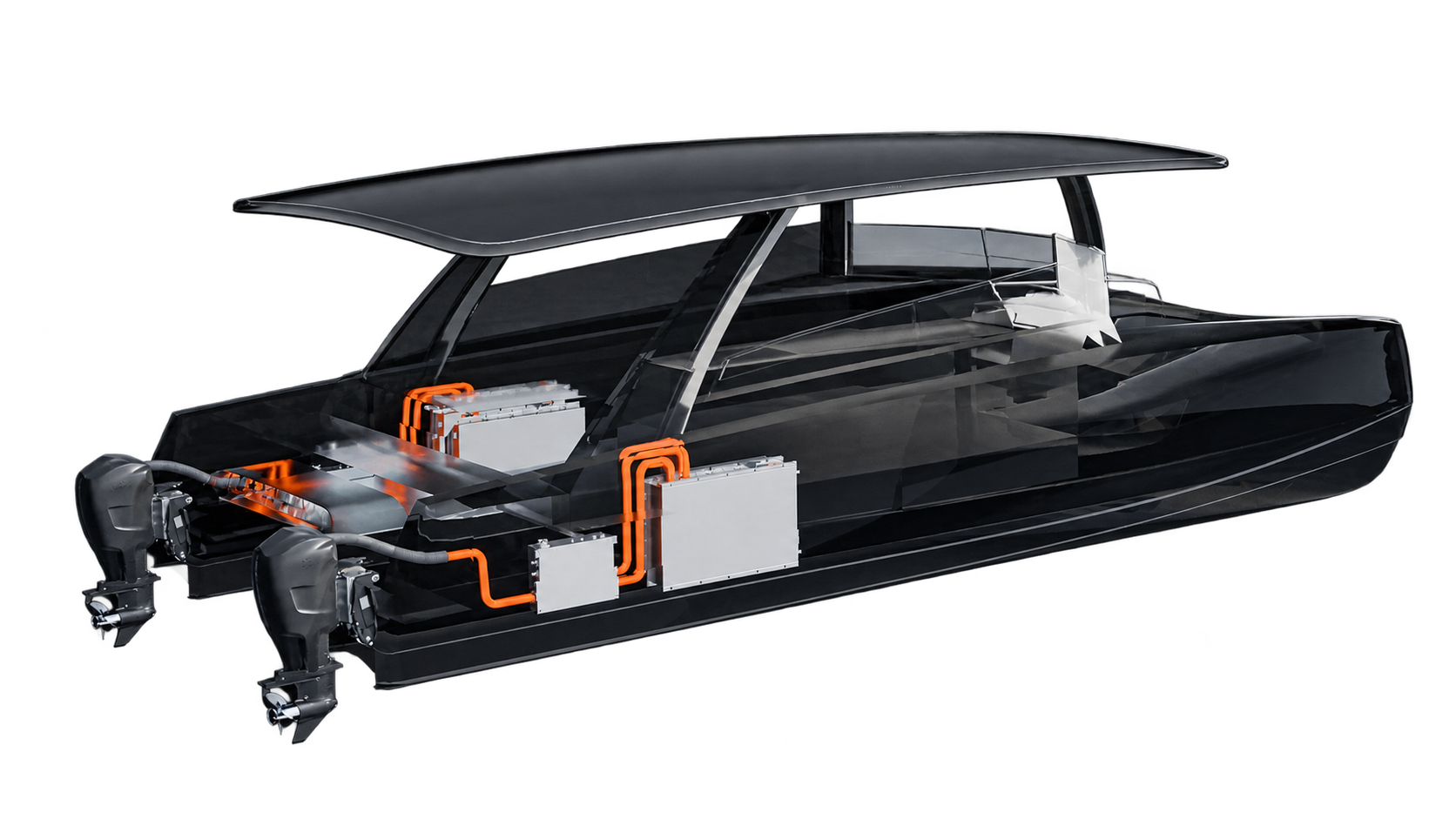
The category spans several very different vessel types. At the compact end are pontoon-style water taxis and tenders used for harbour transfers and private island shuttles. At the larger end are solar-electric catamarans, chosen specifically because a catamaran's twin hulls create a wide, stable deck for solar panels and lower drag for the battery to work against, according to Volta Yachts' explainer on electric catamaran design.
What almost all of them share is a battery bank charged from shore power, solar panels, or both, feeding one or more electric motors instead of an internal combustion engine. Some, like Soel Yachts' SoelCat 12, are designed to be energy-neutral across a sunny day of light excursion use. Others, like the Navier N30 hydrofoil boats now heading to Maldivian resorts, prioritise speed and reduced wake over solar self-sufficiency.
Why Are Resorts and Hotels Switching to Electric Boats in 2026?
Resorts are switching because diesel launches damage the exact experience they are selling: quiet water, clean air, and undisturbed marine life. Sustainability certifications and ESG disclosure requirements now cover guest transport directly, and several major resort transfer projects have moved from pilot to multi-boat fleet order in the past year.
The guest experience problem diesel creates
Soel Yachts has documented this plainly at the Bora Bora Pearl Beach Resort, where more than 50 diesel and outboard-powered excursion and shuttle boats historically needed over 2 million litres of imported fuel every year, with daily boat traffic starting as early as 5am and disturbing guests in overwater bungalows, according to Soel Yachts' own account of the project. That is not an abstract emissions figure. It is engine noise through a bungalow wall at dawn.
The regulatory and ESG pressure
In Singapore, hospitality operators are already being pushed toward electrified guest transport by certifications such as BCA Green Mark and the Global Sustainable Tourism Council (GSTC) criteria, alongside emissions disclosure requirements from the Singapore Exchange Regulation (SGX RegCo), according to sustainability consultancy Greenvolt. A single diesel shuttle van can emit over 4 tonnes of CO2 annually under that framework, a figure the same source uses to illustrate why fleet electrification has moved from marketing nicety to compliance item.
The market is already moving at scale
The clearest signal came in June 2026, when US maritime technology company Navier and Dubai-based JIH Global Investment confirmed a $100 million partnership to build the Navier Network, a software-driven maritime corridor connecting Velana International Airport to resorts, private islands, and local communities across the Maldives, according to Euronews. The rollout starts with five Navier N30 electric hydrofoil vessels before expanding by up to 95 more boats over three years, replacing part of a fleet of roughly 3,000 fuel-powered vessels currently serving the country's 175 resorts, per Travel And Tour World's reporting on official Maldivian tourism data.
How Much Does an Electric Boat Cost for a Resort or Hotel Fleet?
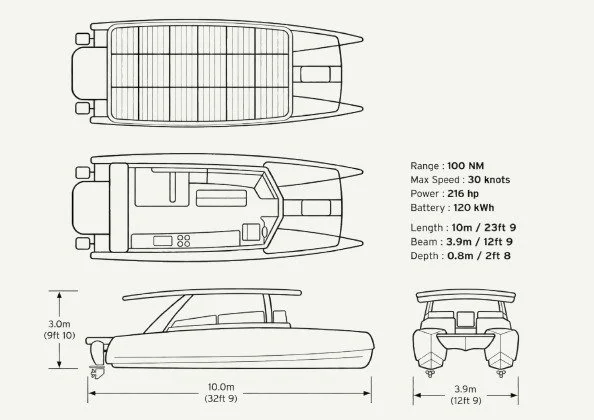
Pricing varies enormously by vessel size and build philosophy. Confirmed public pricing exists for only a handful of models: Chorus's 10-metre solar-electric catamaran Duet launches at £680,000, the launch price for the first 20 orders and excluding VAT, local taxes, delivery and selected options, while most bespoke and commercial electric boat builders, including several Chorus models, price on enquiry rather than a published rate card.
This is normal for the category rather than a red flag. Bespoke UK builders in this space consistently keep granular specification and pricing off their public sites, reserving it for direct commercial conversations once a resort's route length, passenger count, and charging infrastructure are known. Treat any competitor comparison table that claims to know an unpublished builder's exact price or battery capacity with real suspicion, since that data is very rarely made public.
Electric Boats for Resorts Compared: What Different Approaches Deliver
Resort and hotel operators choose between compact water taxis, mid-size solar-electric catamarans, and hydrofoil transfer boats depending on route length, guest volume, and how much they want the vessel itself to be a sustainability talking point.

How Does an Electric Boat Actually Work on the Water?
An electric boat for hotel or resort use draws power from an onboard lithium battery bank, topped up by shore charging, deck-mounted solar panels, or both, and delivers that power through one or more electric motors driving a propeller. There is no fuel tank, exhaust, or gearbox in the conventional sense.
Why catamaran hulls dominate this category
Two slender hulls create a wide, stable beam with lower hydrodynamic drag than a single-hull design, a combination that suits electric propulsion better than almost any other hull form, according to electric-boat marketplace Volta Yachts. Less drag means a smaller, lighter battery bank can still deliver practical range, and the wide deck gives solar panels room to work without compromising passenger space.
What a real-world solar-electric build looks like
Soel Yachts' SoelCat 12, the vessel operating at the Bora Bora Pearl Beach Resort, runs on a 120kWh battery bank powering two 30kW motors, reaching a boost-mode top speed of 14 knots, according to Plugboats' reporting on the build. At a cruising speed of 8 knots the battery alone lasts roughly six hours, extending further on a sunny day as the solar array tops up the bank, per electrive.com's coverage of the launch. When the boat is docked rather than cruising, it can feed up to 15kVA of power back into the resort's grid, enough to run the desalination plant that produces up to 4,000 litres of fresh water an hour, according to Designboom's report on the project.
What Should a Resort Check Before Buying an Electric Boat?
Confirm charging infrastructure compatibility with the marina's existing power supply, ask for a specific route-and-passenger-load range estimate rather than a headline range figure, and get the builder's answer on winter or low-sun performance in writing before signing.
Ask for a route-specific range estimate, not a spec sheet number
A published maximum range figure assumes ideal conditions: light load, calm water, optimum speed. Ask the builder to model your actual route, typical guest load, and local sun hours, and get that estimate in writing. This is standard practice with commercial electric vehicle fleets and applies just as directly to boats.
Confirm shore power capacity before the boat arrives
A resort's existing marina electrical supply was very likely sized for lighting and minor equipment, not for charging a multi-boat electric fleet overnight. Get a qualified marine electrician to confirm available capacity against the builder's stated charging draw before committing to a delivery date.
Understand the maintenance profile is genuinely different
Electric propulsion removes routine diesel maintenance items such as oil changes, fuel filters, and exhaust servicing, but battery health monitoring and eventual cell replacement become the new long-term cost line. Ask any builder directly what a battery replacement costs and after how many charge cycles it is typically needed, and treat a vague answer as a warning sign.
Case Study: How One Resort Replaced Its Excursion Fleet with a Solar-Electric Catamaran
The Bora Bora Pearl Beach Resort, working with Soel Yachts and the Okeanos Foundation for the Sea, launched the SoelCat 12 as the first fully solar-electric excursion catamaran in Bora Bora, positioning it as an example for the wider tourism industry rather than a one-off pilot.
The boat, named Okeanos Pearl, was recognised with the Innovation Award at the 2017 Tourism Awards of French Polynesia and was a finalist for the World Travel and Tourism Council's Tourism for Tomorrow award the same year, according to Plugboats. Its practical value to the resort went beyond guest transport: because the vessel can feed 15kVA back into shore power when docked, the resort has used it to support the desalination plant supplying its fresh water, according to Designboom's coverage.
The wider context is what makes the case study relevant to any resort weighing this decision. Bora Bora's excursion and shuttle fleet historically ran on more than 2 million litres of imported diesel a year across roughly 50 boats, per Soel Yachts' own account. A single solar-electric catamaran did not replace that entire fleet, but it proved the model worked in a real tropical, high-guest-volume resort setting rather than a demonstration tank, and the design became the foundation for Soel Yachts' production SoelCat 12 line.
Is an Electric Boat Right for a Hotel or Resort Charter Fleet?
Electric boats suit charter and resort fleets best on short, repeated routes such as jetty transfers, lagoon excursions, and private island shuttles, where silence and zero local emissions are a direct guest-facing benefit. They are a harder fit for long open-water passages where range and refuelling speed still favour diesel.
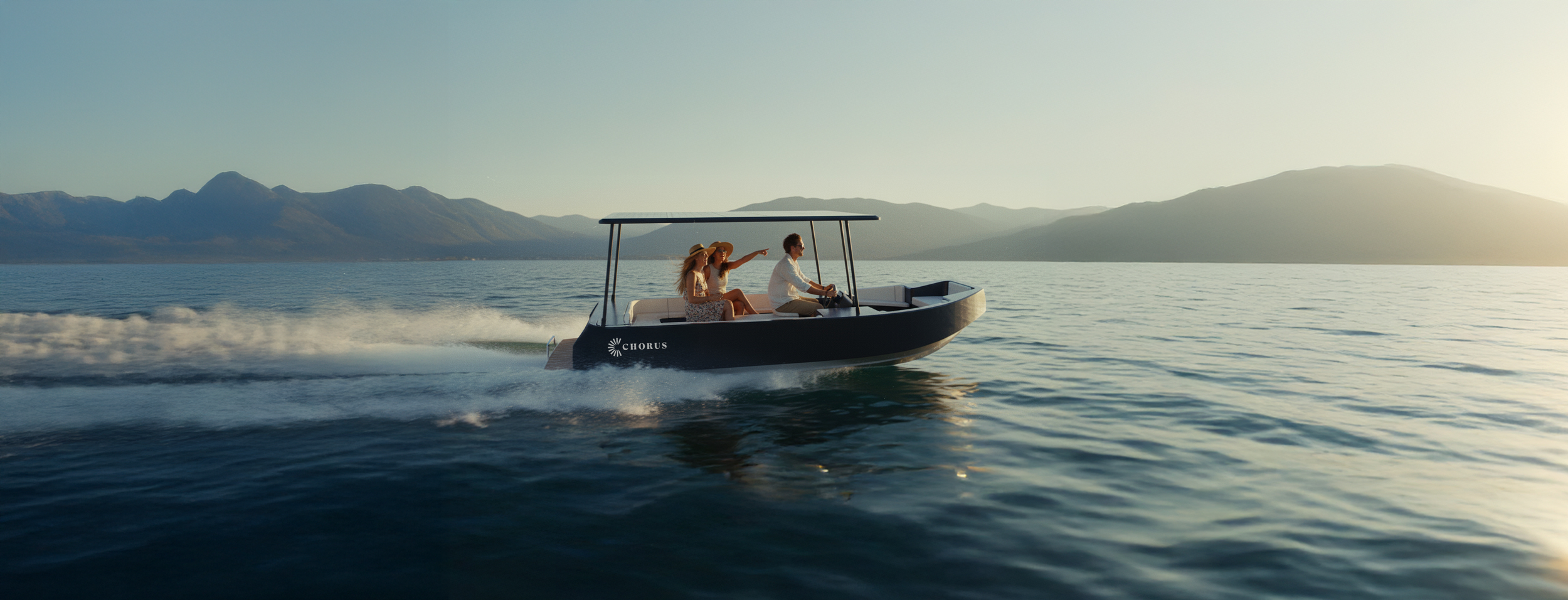
This is the use case Chorus positions its Duet catamaran against: a 10-metre solar-electric vessel built, per Chorus's own site, for operators who need a near-silent, zero-emission platform for resort and charter operations rather than a headline-range cruising yacht. Chorus states that more than 30 million leisure boats worldwide contribute to nearly 1% of global carbon emissions, a figure the company uses on its own site to frame the case for electrification in this segment specifically, rather than shipping generally.
It is worth being precise about scale here. Global commercial shipping, not leisure and charter boats, accounts for roughly 3% of global CO2 emissions, a figure the International Maritime Organization's 2023 GHG Strategy and independent analysis from the International Council on Clean Transportation (ICCT) both cite. Resort and charter fleets sit in a much smaller, separate category, and the case for electrifying them rests on guest experience and local emissions at the jetty, not on a share of that headline shipping figure.
Electric Water Taxi vs Solar-Electric Catamaran vs Hydrofoil: Which Fits Your Property?
Choose an electric water taxi for short, high-frequency harbour or lagoon transfers, a solar-electric catamaran when on-water solar generation and longer daytime excursions matter, and a hydrofoil transfer boat when speed over a longer airport-to-resort route is the priority.
When a water taxi is the right call
Chorus describes its taxi boat as purposefully designed to accommodate larger passenger numbers for harbours, lakes, or city waterways, and positions it specifically for luxury resorts, private island transport, or eco-sensitive urban ferrying, according to Chorus's own site. This is the right category for short, frequent transfers where passenger throughput matters more than range.
When a hydrofoil transfer boat is the right call
The Maldives project exists precisely because airport-to-resort routes there are long, high-frequency, and currently served by a large fuel-powered fleet. Hydrofoil vessels like the Navier N30 fly above the water surface on computer-controlled foils, a mechanism Electrek reports cuts energy consumption by roughly 80% compared with a conventional hull at the same speed, which is what makes longer routes viable on batteries.
Comprehensive FAQ
-
It depends on the vessel type. Solar-electric catamarans and water taxis suit short, repeated routes well. Longer airport-to-resort routes need a purpose-built design such as a hydrofoil, which is exactly why the Maldives project chose hydrofoil vessels over conventional electric hulls for its longest routes, according to Euronews' reporting on the Navier partnership.
-
This depends entirely on local electricity tariffs, battery capacity, and how many boats charge simultaneously, none of which Chorus or comparable bespoke builders publish generically. Ask any builder for a charging-draw figure specific to your fleet size rather than a generic per-boat estimate.
-
Some solar-electric designs can. The SoelCat 12 at Bora Bora Pearl Beach Resort feeds up to 15kVA back into shore power while docked, supporting the resort's desalination plant, according to Designboom. This is a design-specific feature, not something every electric boat offers, so confirm it directly with the builder rather than assuming it.
-
Electric propulsion removes diesel-specific servicing such as oil changes and exhaust maintenance, but introduces battery health monitoring as an ongoing cost. Ask the builder directly about expected battery lifespan in charge cycles and the cost of eventual cell replacement, since this is rarely volunteered upfront.
-
It is a genuine, measurable difference rather than a marketing claim. Diesel and outboard engines produce continuous mechanical noise and vibration that electric motors do not, which is precisely the complaint Soel Yachts documents from guests at Bora Bora Pearl Beach Resort, where daily diesel boat traffic previously started as early as 5am.
-
Yes, typically a dedicated shore power connection sized for the fleet's charging draw, which most existing marina electrical supplies were not built for. Get a marine electrician to audit current capacity against the builder's stated charging requirements before committing to a delivery date.
-
It has moved past niche. The electric boat rental market was valued at roughly $1.4 billion in 2024, according to DataHorizzon Research, and the Maldives' $100 million Navier partnership, confirmed in June 2026, represents one of the largest single hospitality-linked electric marine fleet commitments to date.
-
Battery-only range is unaffected by sunlight, since solar panels only supplement the battery rather than replacing it, but boats that rely heavily on solar top-up for extended daily range will see reduced performance on overcast days. Ask for a stated worst-case range alongside the headline figure before buying.
The Fleet Decision That Actually Matters
Resorts and hotels weighing an electric boat purchase in 2026 are not choosing between a proven technology and an experimental one anymore. The Bora Bora case study is nearly a decade old. The Maldives commitment is backed by $100 million and a phased rollout already underway. What resorts are actually choosing between is route length, guest volume, and how much of the sustainability story they want the vessel itself to tell.
Get a route-specific range estimate in writing, confirm marina charging capacity before delivery, and ask every builder the same direct question about battery lifespan and replacement cost. The property that treats those three questions seriously will make a better fleet decision than the one that buys on the strength of a press release.
For resort and charter operators evaluating a solar-electric catamaran specifically, Chorus's Duet and the broader Chorus range are built around exactly this brief. Get in touch to discuss your route and passenger requirements directly.
