
Electric Pontoon Boat: The Complete UK Guide for 2026
Search for an electric pontoon boat and most of what comes back is American: lake communities with HOA rules banning petrol engines, and manufacturers building pontoons for that exact restriction. It is a real market, but it is not the one most UK buyers are actually shopping in.
In the UK, the electric pontoon conversation looks different. It is about canals, rivers and harbours rather than HOA-restricted lakes, about Canal & River Trust licensing rather than local ordinances, and increasingly about commercial use such as water taxis, eco-tourism and floating events rather than private leisure alone. This guide covers what an electric pontoon boat actually is, how the UK regulatory picture works, what range and running costs look like in practice, and how to judge whether one suits your waterway and your use case.
What Is an Electric Pontoon Boat?

A pontoon boat is built on two or more buoyant hulls supporting a flat, stable deck, which makes it naturally suited to slow, comfortable cruising rather than high-speed performance. An electric pontoon boat replaces the petrol or diesel outboard with a battery-electric motor, removing engine noise, exhaust fumes and the maintenance that comes with an internal combustion engine.
Within that broad category there is a meaningful split. Some electric pontoons rely purely on shore power charging, plugging in between trips like an electric car. Others, including solar-electric pontoons, generate part or all of their own charge from panels integrated into the deck or canopy, extending range without needing a charging point at every stop. For UK operators running tours on stretches of waterway without convenient shore power, that distinction has real practical weight.
Why Pontoons Suit Electric Propulsion Particularly Well
Pontoon hulls are inherently efficient at the low, steady speeds most pontoon use involves. A flat-bottomed, twin or triple-hull design displaces water gently rather than punching through it, which means the power demand per mile is lower than for a planing hull travelling at speed. That efficiency lines up neatly with what battery-electric propulsion is good at, since electric motors deliver strong torque at low speed without the fuel inefficiency a petrol engine suffers at idle or slow cruising.
Electric Pontoon Boats and UK Waterway Regulations
If you are looking at an electric pontoon for canal, river or harbour use in the UK, the licensing picture is different from buying a private leisure boat for a lake in the US, and it pays to understand it before you buy.
Boats used on inland waterways generally need a licence from the relevant navigation authority, most commonly the Canal & River Trust, the Environment Agency, or Scottish Canals depending on where you intend to operate. Most of these waterways also require a Boat Safety Scheme certificate, renewed every four years, which checks electrical systems, propulsion systems and onboard safety equipment rather than focusing solely on fuel systems as older schemes once did.
The Canal & River Trust offers a meaningful incentive for going electric. Boat owners running greener propulsion, including electric narrowboats and pontoons, can claim a discount on their annual licence, reported at around 25 percent off the standard rate for qualifying low-carbon vessels. Reporting from early 2024 noted that despite the Trust licensing roughly 35,000 boats across England and Wales, only around one percent of owners were claiming that discount at the time, suggesting plenty of headroom for uptake to grow as more electric and solar-electric vessels enter the water.
The policy direction reinforces the case further. The UK government has set out an expectation that vessels, including those on inland waters, work toward a 2050 zero-emissions target, with maritime operators expected to show a transition pathway. An electric or solar-electric pontoon is not a hedge against future regulation. It is already positioned where the regulation is heading.
How Far Can an Electric Pontoon Boat Travel?
Range is the question every buyer asks, and the honest answer depends heavily on hull design, battery capacity, motor size and whether the vessel has any solar charging to supplement the battery bank.

Shore-power-only electric pontoons are limited strictly by battery capacity and need recharging once that capacity is used, much like an electric car without a home charger nearby. Solar-electric pontoons change that equation. Modular battery systems combined with integrated solar panels can extend range substantially compared with a battery-only equivalent, since the panels continue contributing charge throughout the day rather than the vessel relying purely on what was in the battery at departure.
In short: a well-specified solar-electric pontoon with a twin-hull design and integrated panels can comfortably manage a full day of frequent-stop operation, such as water taxi shuttles or tour routes, without needing to return to a charging point.
As a concrete example of what is achievable, Chorus Boats' own Hari pontoon is built to carry up to twelve passengers and two crew on a stable twin-pontoon hull, with modular batteries delivering up to 150 km of range that can be extended further through integrated solar charging. For an operator running repeated short shuttle routes, such as a harbour water taxi or a lake eco-tour circuit, that kind of range removes the need for mid-route recharging entirely, which matters operationally as much as it matters environmentally.
Running Costs and Maintenance: What Actually Changes
The case for electric propulsion on a pontoon is not just environmental. It changes the maintenance and running cost picture in ways that matter to both private owners and commercial operators.
Lower Maintenance Burden

Electric motors have drastically fewer moving parts than a petrol or diesel outboard. There is no oil to change, no fuel system to maintain, no spark plugs or filters, and no risk of fuel leaks contaminating the water, which matters particularly for operators running on environmentally sensitive lakes or protected waterways. Fewer moving parts also means fewer things that can fail mid-charter, which is a genuine operational consideration for any business running passenger services.
Fuel Costs Disappear, Electricity Costs Replace Them
There is no diesel or petrol bill with an electric pontoon, but that does not mean running costs hit zero. Shore-power-only vessels still draw electricity from the grid to recharge, and that cost should be factored into any running cost comparison rather than assumed away. Solar-electric vessels reduce that grid dependency significantly, since daylight charging through integrated panels offsets some or most of what would otherwise need to come from a charging point, which is precisely why the distinction between solar-electric and plug-in-only matters so much for total cost of ownership, not just for environmental positioning.
Electric Pontoon Boats for Commercial Use in the UK
Private leisure ownership is only part of the picture. In the UK, electric and solar-electric pontoons are increasingly being specified for commercial applications where the combination of low running costs, quiet operation and zero local emissions becomes a genuine competitive advantage rather than just a sustainability talking point.
Water Taxis and Shuttle Routes

Harbours, resorts and waterfront developments looking to offer passenger transport benefit from a pontoon's stability and passenger capacity combined with the low noise and zero exhaust emissions of electric propulsion, which matters considerably for routes running close to residential moorings or sensitive waterfront environments where engine noise and fumes would otherwise be a constant complaint.
Eco-Tourism and Wildlife Tours
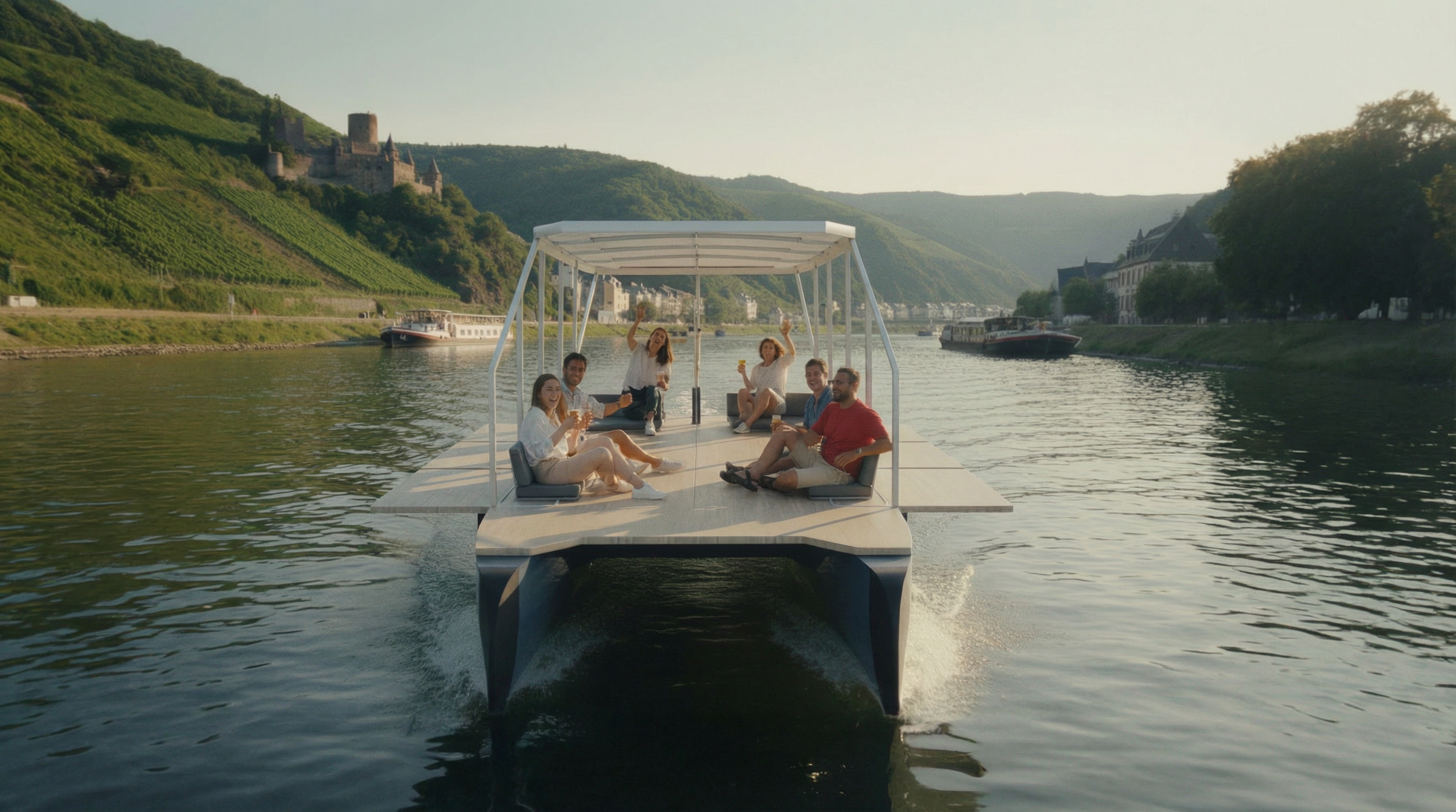
Near-silent electric propulsion is a genuine asset for wildlife watching and nature tours, where engine noise disturbs the exact experience visitors are paying for. A pontoon's open, stable deck also suits sightseeing better than a narrower hull, giving every passenger an unobstructed
view rather than cramming people toward one side of the boat.
Floating Events and Hospitality
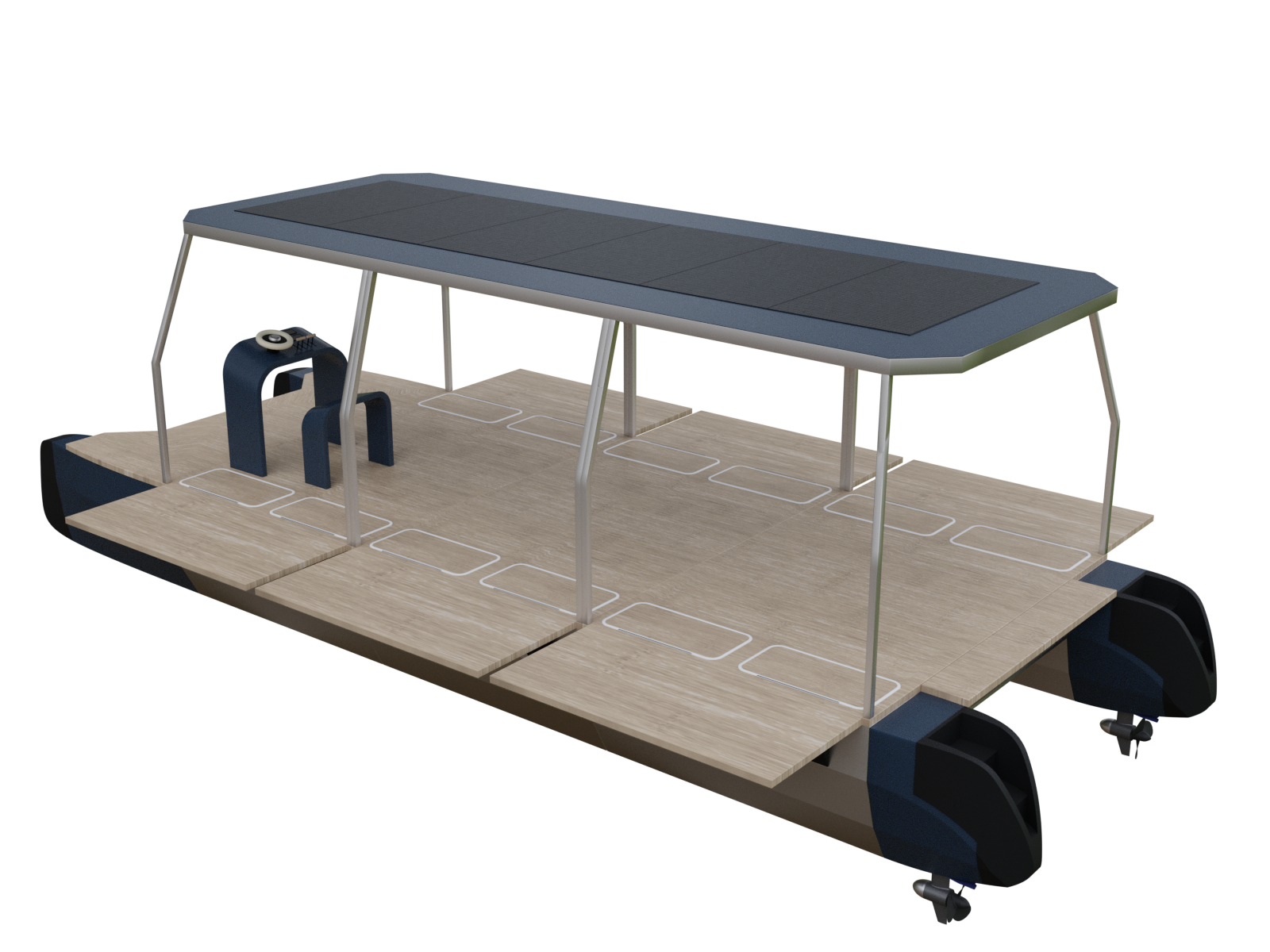
A pontoon's flat, open deck lends itself naturally to floating bars, private event charters and hospitality use, and removing engine noise and vibration from that environment matters directly to the guest experience rather than being a secondary benefit. Modular deck layouts also let operators reconfigure the same vessel between a daytime tour boat and an evening event charter without structural changes.
Comparing Electric Pontoon Options
The table below sets out the broad categories of electric pontoon on the market and where each genuinely fits.
| Type | Charging Method | Best Suited To | Key Limitation |
|---|---|---|---|
| Shore-power electric | Plug-in only, mains or marina charging point | Short trips with reliable access to charging infrastructure | Range limited strictly by battery size between charges |
| Hybrid electric | Battery plus small generator backup | Buyers wanting a safety net for longer or unpredictable trips | Retains some emissions and maintenance from the generator |
| Solar-electric | Integrated panels plus battery, with or without shore charging | All-day operation, frequent-stop routes, limited charging infrastructure | Output varies with daylight and weather conditions |
| Trolling motor conversion | Small battery pack, low-power motor retrofit | Slow leisure cruising on small lakes or rivers, budget-conscious buyers | Low power ceiling, not suited to commercial passenger loads |
For UK commercial operators in particular, solar-electric tends to offer the best balance, since it reduces dependency on charging infrastructure that may simply not exist at every mooring or harbour stop along a route.
Common Mistakes When Choosing an Electric Pontoon
A few recurring issues are worth flagging plainly rather than glossing over.
Judging range purely from manufacturer headline figures rather than asking how that range was tested, since quoted figures often assume ideal conditions rather than typical UK weather and usage patterns.
Overlooking the Boat Safety Scheme certificate requirement, which applies to the electrical and propulsion systems on an electric pontoon just as it does to a conventional engine, not just fuel systems.
Assuming all electric pontoons are eligible for the Canal & River Trust low-carbon discount without checking the specific qualifying criteria with the licensing authority directly.
Underestimating charging infrastructure availability along an intended route, particularly for canal and river cruising rather than marina-based use, where shore power points may be limited.
Frequently Asked Questions
-
You need the standard licence from the relevant navigation authority, such as the Canal & River Trust or Environment Agency, the same as for any motorised boat. There is no separate licence category purely for electric propulsion, though several authorities offer a discount on the standard licence fee for qualifying low-carbon vessels.
-
This depends entirely on battery capacity and charger output, and varies significantly between models. Solar-electric pontoons reduce the practical need for full shore-power charging between every use, since daylight panel charging tops up the battery throughout the day rather than the vessel relying solely on overnight charging.
-
Generally not at top speed, since pontoon hulls and electric motors are both optimised for steady, efficient cruising rather than outright pace. For the vast majority of pontoon use cases, including tours, water taxis and leisure cruising, this is not a practical drawback, since speed was rarely the point of choosing a pontoon in the first place.
-
Yes, and this is one of the fastest-growing applications in the UK, particularly for water taxis, eco-tourism operators and event hire businesses. Commercial passenger use brings additional regulatory and insurance requirements beyond standard private leisure use, so operators should confirm specific commercial licensing and certification requirements with the relevant navigation and maritime authorities before launching a service.
-
It behaves like any battery-powered vehicle running flat: propulsion stops until recharged or towed. This is precisely why range planning matters so much when choosing between shore-power-only and solar-electric options, since a solar-electric vessel with genuine daylight charging capacity has a meaningfully larger safety margin on longer or multi-stop routes.
-
Generally yes. Electric motors have far fewer moving parts than internal combustion outboards, eliminating oil changes, fuel system servicing, spark plugs and the routine wear items that come with a petrol or diesel engine. This typically translates into lower long-term maintenance costs, though the battery system itself still requires its own maintenance and eventual replacement planning.
-
It depends on use case. For occasional leisure use with reliable access to shore charging, the extra cost of integrated solar may not be essential. For commercial operators running frequent routes, multi-stop tours, or operating where charging infrastructure is limited, the extended range and reduced charging dependency that solar panels provide tend to justify the investment.
Is an Electric Pontoon Boat Right for You?
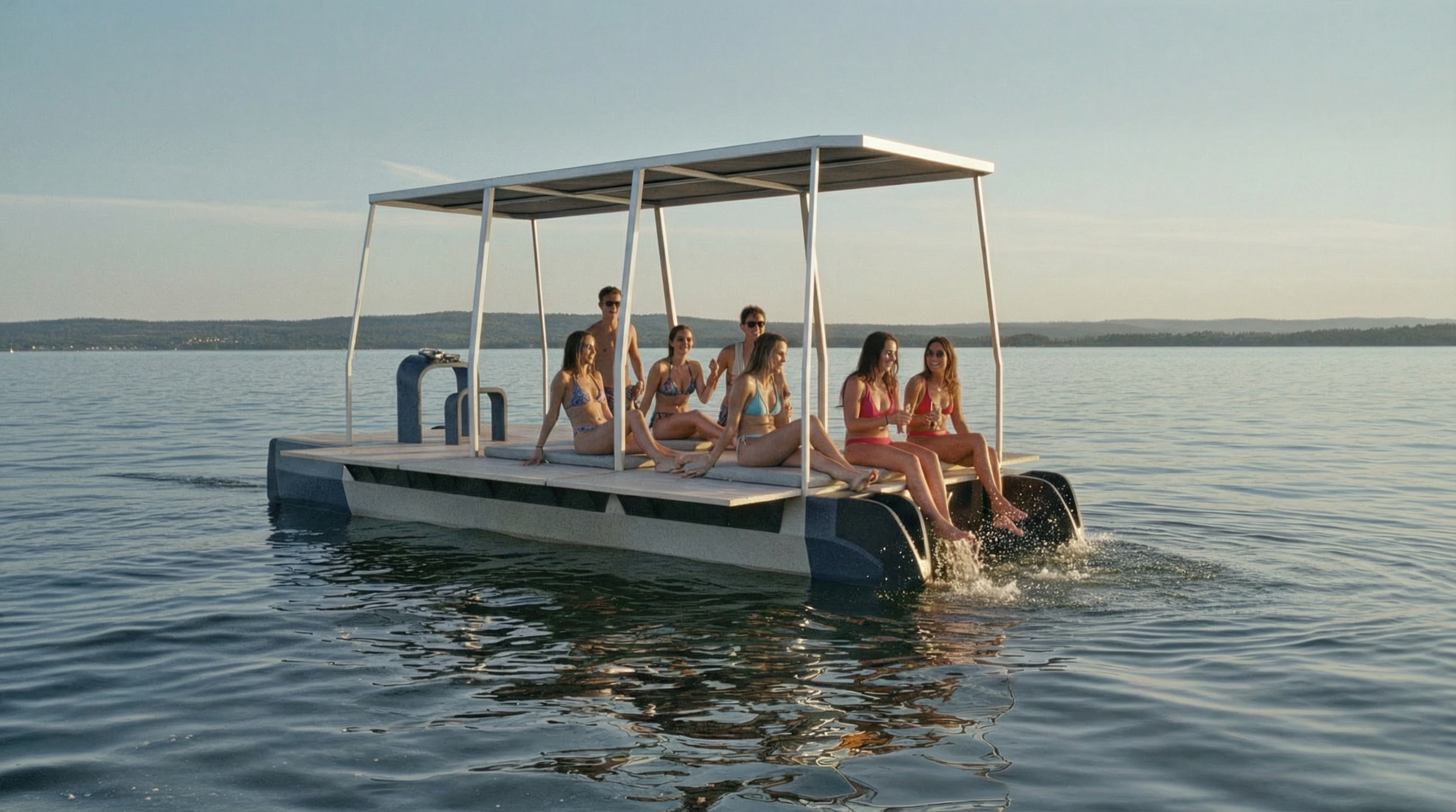
The answer depends heavily on where you intend to use it and what you are using it for. For private leisure cruising on a single lake or a familiar stretch of river with reliable shore power nearby, a straightforward shore-power electric pontoon may be all you need. For commercial operators running water taxis, eco-tours or event charters across a working day, particularly where charging infrastructure cannot be guaranteed at every stop, solar-electric propulsion earns its place through range and operational flexibility rather than through sustainability messaging alone.
Either way, the direction of travel in the UK is clear. Licensing incentives favour low-carbon vessels, the regulatory backdrop is pushing toward zero emissions rather than away from them, and the running cost and maintenance advantages stack up regardless of how strongly any individual buyer cares about emissions specifically. An electric pontoon boat in 2026 is no longer a niche choice. It is simply a well-reasoned one.
